
Military Retirement vs. Separation: What Every Transitioning Service Member Needs to Understand
Your DD-214 may look like a single sheet of paper, but the lines describing how and why you left military service can shape your income, healthcare, benefits, and options for decades.
Retirement versus separation isn't just a paperwork distinction — it's the difference between monthly retired pay and continued TRICARE eligibility on one hand, and a one-time payment or having to secure each individual benefit you've earned on the other.
If you're approaching an ETS date, a medical board, force shaping, or a command-directed transition, don't let the out-processing pace rush you into signing off on things you haven't fully read.
This is one area where getting the details right matters more than almost anything else in the transition process.
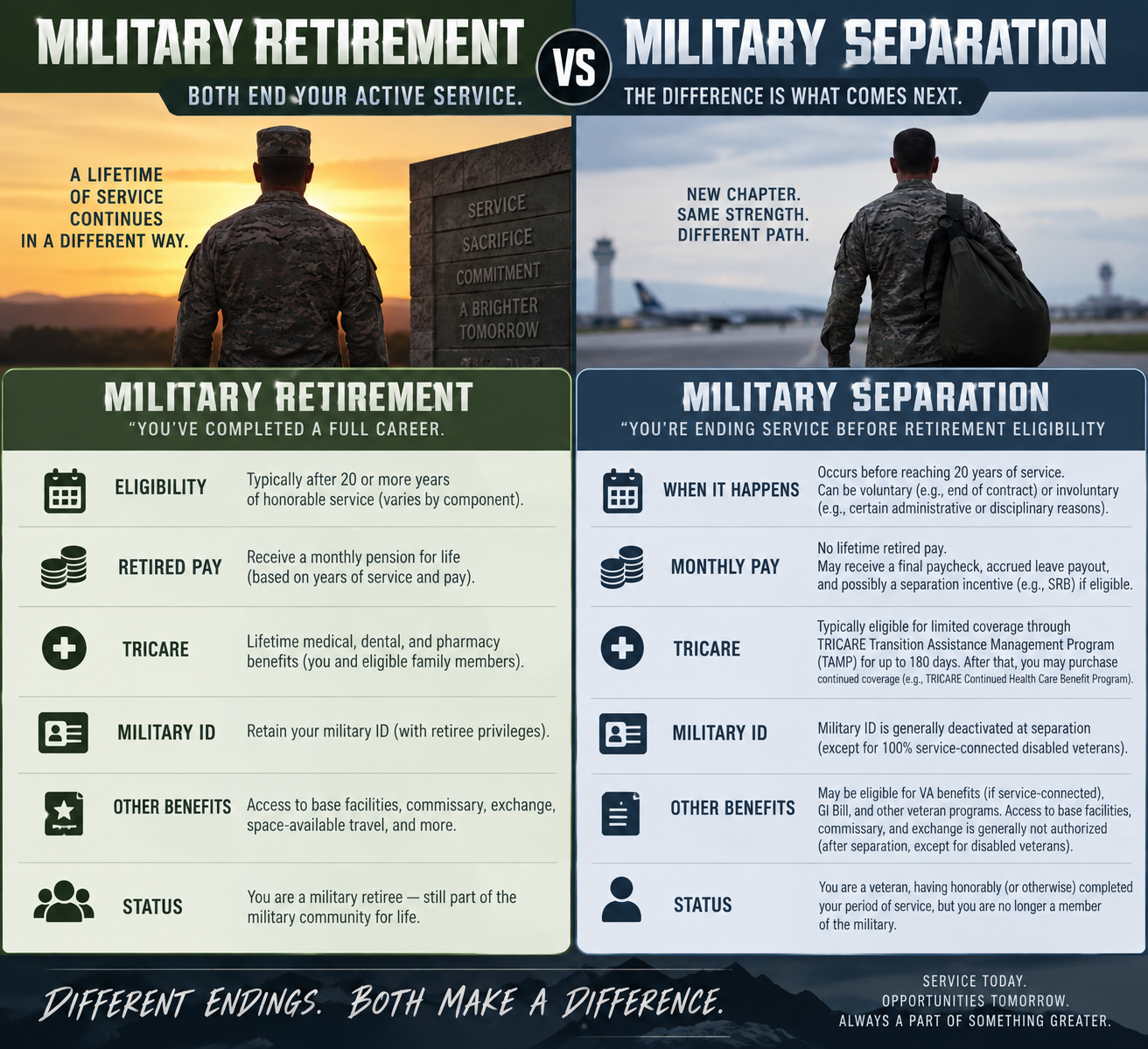
The Core Difference
Military retirement generally means you completed enough qualifying service to retire, or you were found medically unfit under circumstances that qualify for disability retirement.
Depending on the type of retirement, benefits can include:
Monthly retired pay
A retired military ID
TRICARE retiree coverage
Commissary and exchange privileges
Installation access
Military separation means leaving military service without entering retired status.
Some separations are routine — completing an enlistment and choosing not to reenlist. Others are involuntary, administrative, or medical.
A separation can still be honorable and can still carry significant VA-eligible benefits, but it typically does not include the lifetime pension or retiree healthcare associated with military retirement.
That word typically matters. This space is full of exceptions and eligibility rules shaped by your branch, years of service, disability findings, and characterization of service.
The VA's transition assistance resources are a good starting point for understanding what may apply to your specific situation.
Standard Retirement, By the Numbers
Regular active-duty retirement after roughly 20 years of creditable service is what most people picture when they hear "military retirement."
How much retired pay you receive depends on which retirement system applies to you.
Under the Blended Retirement System (BRS), the multiplier is generally 2% per year of service, or 40% at 20 years.
Under the legacy High-3 retirement system, the multiplier is generally 2.5% per year, or 50% at 20 years.
You can learn more about military retirement systems through the Department of Defense Military Compensation website.
Those percentages understate the real value, though.
Retiree healthcare, annual cost-of-living adjustments, survivor planning, and decades of monthly income can make military retirement a substantial financial asset beyond the pension percentage alone.
Retired pay is generally subject to federal income tax, although disability retirement can be treated differently. State taxation also varies significantly, which is worth factoring in if retirement also means relocating.
Guard and Reserve Retirement Works Differently
National Guard and Reserve retirement causes plenty of confusion.
Reaching 20 qualifying years doesn't necessarily mean a retirement check starts the following month.
A Reserve Component member who reaches 20 qualifying years receives a Notice of Eligibility for Retired Pay — commonly called the "20-year letter" — but retired pay normally doesn't begin until age 60.
Certain qualifying service performed after January 28, 2008, can reduce that starting age in three-month increments.
That gap catches people off guard regularly.
It's worth verifying your retirement points, qualifying service, and expected pay start date directly rather than relying on secondhand information.
Medical Retirement vs. Medical Separation
This is where the retirement-versus-separation distinction can become especially important.
When a medical condition prevents someone from performing their military duties, the case may enter the Disability Evaluation System (DES), which determines whether the service member returns to duty or separates due to disability.
For someone with fewer than 20 years of service, a DoD disability rating of 30% or higher for conditions determined to be unfitting generally results in disability retirement rather than separation, potentially placing the member on the Permanent Disability Retired List or Temporary Disability Retired List.
Members who have already reached 20 years fall under additional provisions. That's exactly why the common shorthand of "30% means retirement, 20% means separation" shouldn't be treated as a universal rule.
Below the 30% threshold, an unfitting condition can result in medical separation, with eligibility for disability severance pay in some cases.
This distinction can affect retired status, healthcare eligibility, and household income for decades.
If you're going through a medical board, this deserves your full attention.
Your DoD Rating and Your VA Rating Are Not the Same Thing
One of the most common points of confusion during medical transition is assuming a DoD disability rating and VA disability rating mean the same thing.
They don't.
The Department of Defense is evaluating whether a condition makes you unfit for continued military service.
The Department of Veterans Affairs evaluates service-connected disabilities under its own compensation framework.
It's entirely possible to receive a relatively low DoD rating and a substantially higher VA rating. One doesn't automatically predict the other.
For information about VA disability compensation and eligibility, visit the VA Disability Compensation page.
Separation Isn't a Single Category
An honorable separation at the end of a standard enlistment can look very different from a separation involving misconduct, a medical condition, force reduction, or an adverse characterization of service.
Someone finishing a contract and moving on to school has a very different situation from someone involuntarily separated who may qualify for separation pay, or someone medically separated who may qualify for disability severance pay.
A standard separation doesn't erase what you've earned.
Depending on individual eligibility, veterans may remain eligible for benefits such as:
VA disability compensation
VA healthcare
Education benefits
VA-backed home loan benefits
Veteran employment programs
Separation Pay Can Come With Strings Attached
Involuntary separation pay or disability severance pay can genuinely ease a transition — but it isn't necessarily unconditional.
Certain separation and severance payments can later be subject to recoupment, including through VA disability compensation.
Before building a budget around a lump-sum payment, confirm exactly what type of payment it is and whether recoupment applies.
The Real Gap Is Healthcare, Not Just the Pension Check
The most visible difference between retirement and separation is predictable monthly income — a meaningful cushion for a family navigating a move, career change, or return to school.
But healthcare access is often just as important.
Military retirees generally remain eligible for TRICARE, although retirement is a Qualifying Life Event that requires action to maintain appropriate coverage.
You can review current requirements directly through TRICARE's Retiring From Active Duty information.
For those who separate rather than retire, regular active-duty TRICARE eligibility generally ends when active duty ends, although some separating members may qualify for transitional coverage through the Transitional Assistance Management Program (TAMP).
After that, separated veterans typically rely on employer coverage, VA healthcare if eligible, a spouse's plan, or private insurance.
VA healthcare can be a strong resource, but it isn't a direct substitute for TRICARE. The two systems operate under different eligibility and coverage rules.
Learn more about VA Healthcare Eligibility.
VA Disability and Retired Pay Can Interact in Complicated Ways
VA disability compensation is technically separate from military retired pay, but rules can require retired pay to be reduced by VA compensation through what's commonly known as the VA waiver or offset.
Two programs can change that outcome:
Concurrent Retirement and Disability Pay (CRDP)
CRDP can restore retired pay for qualifying military retirees.
Combat-Related Special Compensation (CRSC)
CRSC provides tax-free compensation for qualifying retirees with combat-related disabilities.
A retiree may potentially qualify for both programs but cannot receive both simultaneously.
This is complex enough that it's worth going directly to the official Defense Finance and Accounting Service (DFAS) information rather than piecing together the rules from secondhand sources.
File Your VA Claim Before You Leave, If You Can
If a VA disability claim is likely in your future, one of the best times to begin the process is before your final day in uniform.
The Benefits Delivery at Discharge (BDD) program allows eligible service members to file a VA disability claim 180 to 90 days before separation.
This gives the VA time to gather evidence and schedule examinations while you're still serving.
You can review eligibility and filing requirements on the VA's Benefits Delivery at Discharge page.
If you're already inside that 90-day window, you can still file a claim — it simply won't route through BDD.
Documentation matters just as much.
Any injury, chronic pain, illness, or mental health concern that began or worsened during service should be documented honestly while your medical records and treatment history are still accessible.
Too many veterans spend years afterward trying to reconstruct something that could have been clearly established before leaving service.
Build Your Own Exit File Before You Sign Anything
Whether retiring or separating, build a personal records archive before leaving.
Don't rely on a government portal remaining accessible indefinitely, and don't assume a past unit will be able to locate something years later.
At minimum, preserve copies of your:
DD-214
Separation or retirement orders
Service treatment records
Evaluations
Award citations
Deployment records
Medical board paperwork
Relevant personnel records
Keep digital copies in more than one secure location.
Review your DD-214 carefully before leaving. Dates of service, character of service, awards, and other entries are far easier to address while you still have access to the people and records needed to prove an error.
Your DD-214 follows you into veteran life. Treat the final review accordingly.
Don't Overlook Everything Else You've Earned
Your Thrift Savings Plan stays yours regardless of how you leave military service.
Review your options directly through TSP.gov before rolling the money into anything else.
Confirm your education benefits through the VA Education and Training portal.
If applicable, review your VA Home Loan eligibility.
You should also understand what happens to your Servicemembers' Group Life Insurance and whether converting to another form of coverage makes sense for your situation.
And don't assume VA healthcare enrollment happens automatically. It doesn't.
Start Translating Your Career Before You Leave
Benefits are only half of this transition.
The other half is what comes next professionally.
Your MOS or branch-specific role may mean everything to another veteran and almost nothing to a civilian hiring manager.
For example:
"Accountable for sensitive items" can become experience in inventory control, compliance, asset accountability, and risk mitigation.
"Squad leader" can become leading and training teams under pressure while managing personnel, equipment, readiness, and operational requirements.
This applies at every level of military service, including senior leadership roles.
The goal isn't to inflate what you did.
It's to make your experience legible to someone without a military frame of reference.
Choosing the Right Path for Your Situation
If you're close to a full retirement, the financial difference between staying and leaving can be enormous — but that doesn't mean staying in a genuinely bad situation purely for the pension is automatically the right decision.
Family health, personal health, career opportunities, finances, and quality of life all belong in that calculation.
Run the actual numbers:
Healthcare costs
Military retired pay
VA disability compensation
TSP assets
Potential CRDP or CRSC eligibility
Civilian earning potential
Family expenses
Relocation costs
Make the decision with as much accurate information as possible rather than under the pressure of an approaching transition date.
If a medical condition is driving the decision, treat the formal process seriously.
Attend every appointment. Read the proposed findings carefully. Understand which conditions were determined unfitting. Use available legal counsel or advocacy resources when something doesn't add up.
Medical retirement versus medical separation isn't a minor technical distinction. It can affect lifetime benefits for you and your family.
You Don't Have to Sort This Out Alone
The instinct to treat asking for help as weakness doesn't serve you during transition.
The Department of Defense Transition Assistance Program provides structured transition resources for service members preparing to leave the military.
Military OneSource also provides transition assistance and resources for service members and military families.
For VA claims specifically, consider working with a VA-accredited representative or Veterans Service Organization.
For retirement pay questions, go directly to DFAS.
For military healthcare questions, use TRICARE.
Don't base decisions that can affect decades of benefits on secondhand recollections from someone else's transition years ago.
The Bottom Line
If you're separating after a single enlistment, that service doesn't require justification. The next mission is building a life worth what you gave.
If you're retiring after a career, the uniform eventually comes off, but retired pay, TRICARE, VA disability, TSP, and civilian employment all still deserve deliberate planning before the final day.
Understand the system before it makes decisions you don't fully understand.
Secure your records. Read your DD-214 closely. Verify your benefits. Ask questions until the answers actually make sense.
What you earned while wearing the uniform shouldn't disappear the moment you take it off.
Need Help Planning Your Transition?
Decisions this significant — whether to stay for retirement, how to handle a medical transition, or how to plan the financial and career side of leaving military service — deserve more than a blog post.
Schedule a Free Consultation and we'll work through your specific situation.
This article is intended for general informational purposes and should not be considered legal, financial, medical, tax, or benefits advice. Military and veteran benefits depend on individual circumstances and current regulations. Verify eligibility and requirements directly with the appropriate government agency before making significant decisions.